You train hard. Maybe you chase mileage on the Boulder trails, push heavy barbells in a CrossFit class, or work on your swing at the course. Then a nagging pain shows up, and suddenly your training plan is on hold.
If you have tried physical therapy before, you may know the frustration. Short visits, a handout of generic exercises, and a therapist splitting time between several patients can leave you managing symptoms instead of solving the problem. You want to know why it hurts, and you want a clear path back to your sport at full strength.
That is exactly what Fullswift Physio + Performance was built to deliver. This guide walks you through how manual therapy, performance testing, and sport-specific care for running, CrossFit, and golf can help you recover and perform better in Boulder.
Why Generic Physical Therapy Falls Short for Active People
Most injuries in active people are not random. They tend to come from a mix of training load, movement patterns, tissue restrictions, and gaps in strength or control. Treating only the sore spot often brings short-term relief, but the pain returns when you ramp training back up.
General care also tends to stop when pain stops. For an athlete, that is only the halfway point. Pain-free walking is a different standard from running a long trail descent, hitting a heavy snatch, or rotating through 18 holes.
A performance-focused approach changes the picture in several key ways:
-
Root causes over symptoms: Your pain is mapped back to the movement, strength, or mobility factors driving it.
-
Sport-specific goals: Your plan is built around what you need to do, not just what hurts.
-
Progressive loading: You rebuild capacity step by step so your body is ready for the demands of training and competition.
-
Dedicated clinician time: Real progress requires real attention, not a rushed hand-off.
How Manual Therapy Helps Athletes Move and Recover
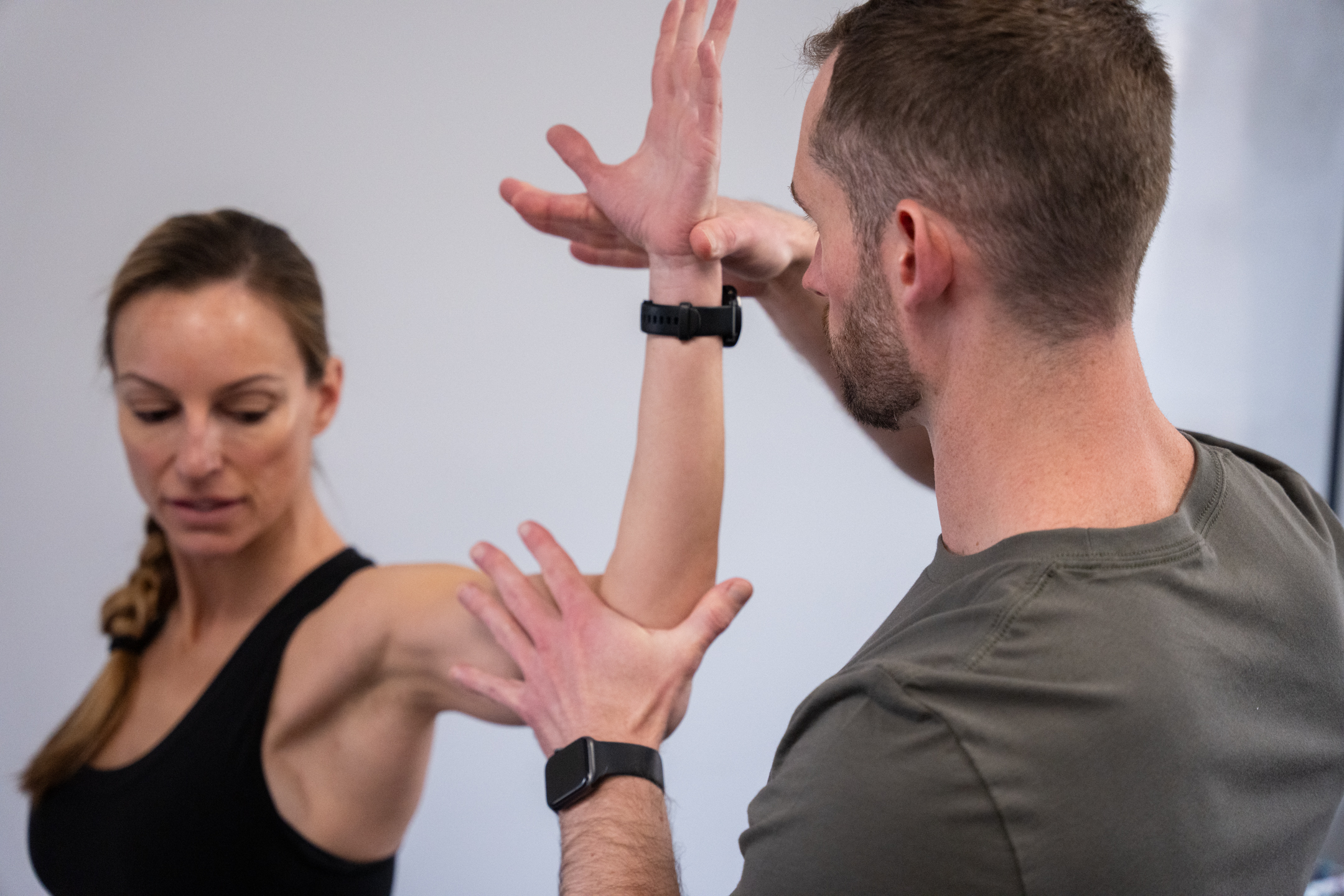
Manual therapy is a hands-on approach where your physical therapist uses skilled techniques to influence joints, muscles, fascia, and the nervous system. Research supported by organizations like the American Physical Therapy Association recognizes manual therapy as an effective component of a broader plan that includes exercise, particularly for musculoskeletal pain and movement limitations.
The key phrase is part of a broader plan. Hands-on work can open the door to better movement, but it works best when paired with strength and motor control training that locks in the change.
Manual Therapy Techniques Used at Fullswift
Your treatment is matched to what your evaluation reveals. At Fullswift Physio + Performance, your toolkit may include:
-
Joint mobilization and manipulation to improve stiff or restricted joints, such as the hips, thoracic spine, ankles, or shoulders
-
Myofascial release and soft tissue mobilization to address tight, overworked tissue
-
Trigger point therapy for localized, painful muscle knots
-
Dry needling to target myofascial trigger points, reduce pain, and improve movement
-
IASTM (Graston-style instrument work) to address scar tissue and fascial restrictions
-
Cupping (myofascial decompression) to improve how tissue glides and responds
-
Taping to support or cue better movement patterns during training
Not every athlete needs every technique. Your clinician selects what fits your body, your sport, and your timeline.
Conditions Manual Therapy Can Support
Manual therapy is commonly used alongside exercise for issues that affect active people, including low back pain, neck pain, shoulder pain, rotator cuff problems, hip pain, knee pain, Achilles tendinopathy, plantar fasciitis, and general overuse injuries. Your plan always extends beyond the treatment table, because lasting change comes from teaching your body to hold the improvement.
What Happens in a 90-Minute Initial Evaluation
Your first visit at Fullswift is not a quick intake. It is a comprehensive 90-minute evaluation with a Doctor of Physical Therapy, designed to find the root cause of your problem rather than simply naming the painful area.
This extended time allows for a level of depth that a short appointment simply cannot provide. We listen to your full story, including your training history, past injuries, and goals. Then we examine how you move and where things break down.
Depending on your needs, your evaluation may include:
-
A detailed history of your pain, training, and sport demands
-
A movement screen and functional movement assessment
-
Joint mobility, strength, and motor control testing
-
Running gait analysis or form observation if running is part of your goals
-
A functional breathing assessment when breathing mechanics may be affecting performance
-
A clear explanation of findings and what they mean for your recovery
You leave with a plan, not just a diagnosis. Because no referral is needed for physical therapy in Colorado, you can book directly when you are ready to get answers.
Running Physical Therapy in Boulder
Boulder is a runner's town. Hills, altitude, and trail miles are part of the appeal, and they also place real demands on your tendons, joints, and muscles. Many runners come to Fullswift with problems such as runner's knee (patellofemoral pain), IT band syndrome, shin splints, Achilles tendinopathy, plantar fasciitis, or hamstring strains.
Running injuries often involve a combination of training load changes and how force moves through your body. A one-size-fits-all stretching list rarely solves the problem, which is why a thorough assessment of mechanics, strength, and load management is essential.
How Running Gait Analysis and Form Assessment Help
A running gait analysis examines how you move while you run, including how your hips, knees, ankles, and trunk share the work. A running form assessment helps identify patterns that may be adding stress to certain tissues or limiting your efficiency.
We pair what we observe with findings from the table and strength testing. For example, limited hip mobility or weak hip control may show up as stress at the knee, and a stiff ankle may change how your foot and Achilles handle load.
What Running Treatment Includes
Your plan may combine:
-
Manual therapy to restore mobility and calm irritated tissue
-
Therapeutic exercise for the hips, core, calves, and feet
-
Neuromuscular re-education to improve control and coordination
-
Plyometrics and progressive loading to prepare you for impact
-
Blood flow restriction (BFR) training to build strength with lighter loads when appropriate
-
A gradual return-to-running plan matched to your goals
Whether you are working back from an injury or staying healthy through a big training block, the goal is the same: more miles, fewer setbacks.
CrossFit Physical Therapy: Staying Strong Under Load
CrossFit asks a lot from your body. Heavy lifts, gymnastics skills, and high-intensity conditioning all stack up, and small movement limitations can turn into significant problems under load. Common trouble spots include the shoulders, low back, hips, knees, elbows, and wrists.
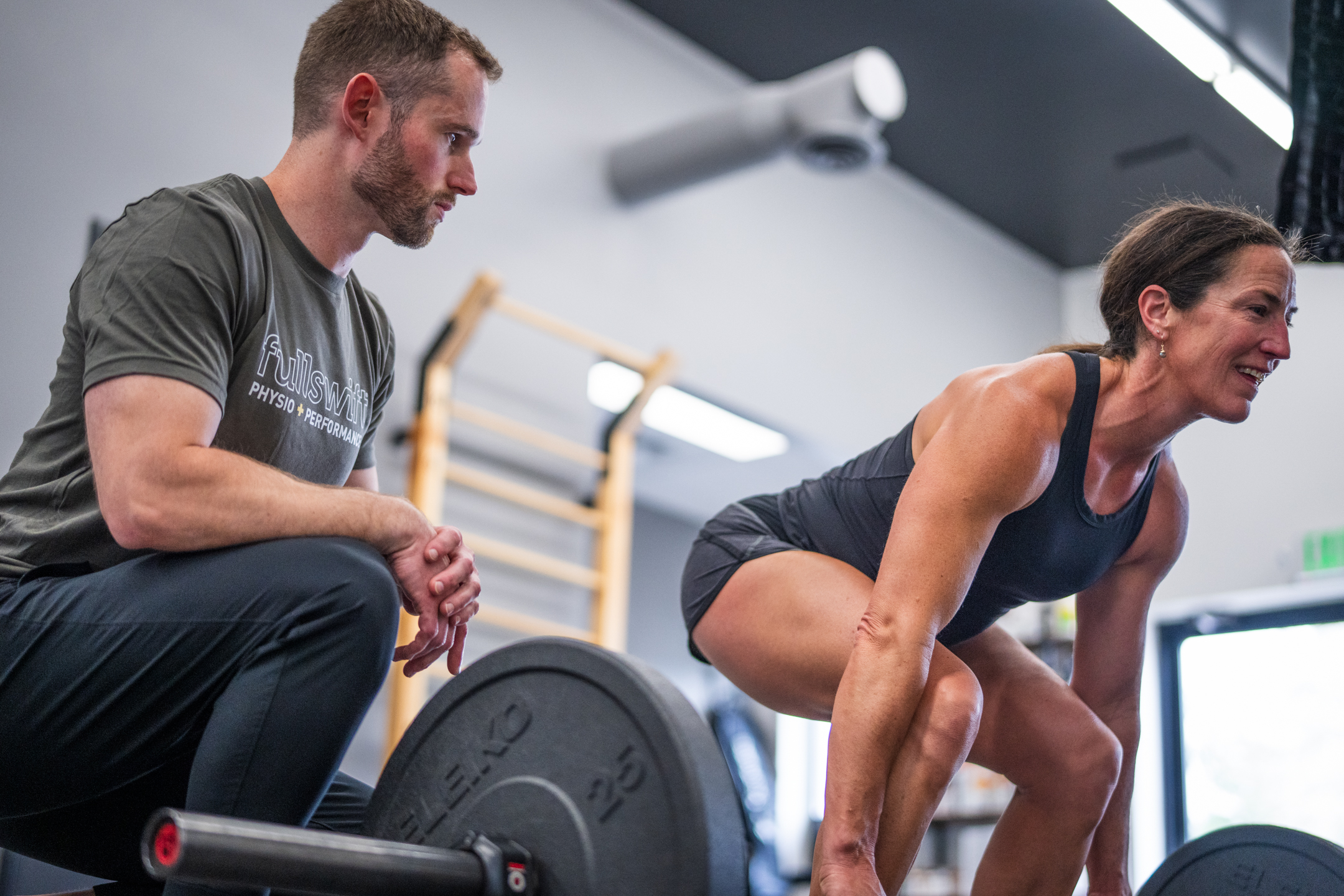
At Fullswift Physio + Performance, our clinicians bring strength and conditioning credentials, including CSCS and USA Weightlifting backgrounds, to the clinic. That means we understand what a snatch, overhead squat, or kipping pull-up actually demands from your joints, and we can speak the language of your sport.
What Your CrossFit Plan Focuses On
We analyze how you move through the patterns you perform every day in class, then build your plan around them:
-
Movement analysis of squatting, hinging, pressing, and overhead positions
-
Manual therapy and dry needling to improve mobility or reduce pain that limits your positions
-
Strength work to address the gaps behind recurring aches
-
BFR training to maintain or build strength when heavy loading needs to be modified
-
Return-to-sport testing and progressions so you return to full intensity with confidence
In most cases, you do not have to stop training entirely. We work with you to modify what you can, rebuild what you need, and reintroduce the rest in smart, progressive steps.
Golf Physical Therapy: Better Movement, Better Swing
Golf looks gentle, but the swing is a fast, repeated rotational movement that loads your spine, hips, shoulders, and elbows. Golfers commonly deal with low back pain, hip pain, shoulder pain, and golfer's elbow. Limited rotation in one area often forces another area to compensate, which is how overuse pain develops.
Our approach starts with how your body moves. A movement analysis and functional movement assessment can reveal whether your hips, thoracic spine, or shoulders are limiting your rotation, or whether stability and control are the missing pieces.
From there, your plan might include:
-
Joint mobilization and soft tissue work for the hips, upper back, and shoulders
-
Myofascial release or dry needling for stubborn restrictions
-
Core and hip strengthening to support rotational power
-
Balance and proprioception training to improve control through the swing
-
Exercises that mirror the demands of your game so gains carry over to the course
The result is a body that is more comfortable and better prepared to rotate, load, and repeat your swing round after round.
How Performance Testing Guides Your Recovery
Testing turns guesswork into a plan. Instead of assuming what is holding you back, we measure it. Fullswift Physio + Performance offers a range of performance services that go beyond a standard physical therapy visit:
-
Running gait analysis and running form assessment to evaluate movement efficiency and load patterns
-
VO2 max testing to measure aerobic capacity and guide training intensity
-
Movement screens and functional movement assessments to identify mobility, stability, and control limitations
-
Isokinetic and dynamometer testing to objectively measure strength and compare sides
-
Return-to-sport testing to confirm you are ready for the demands of your activity
This data matters most when you are coming back from an injury. Pain going away does not always mean strength, power, and control have fully returned. Objective testing helps you and your clinician decide when it is time to progress.
The Fullswift 3-Step Process
Every athlete is different, but the path follows a clear structure designed to take you from stuck to strong.
Step 1: Comprehensive Evaluation
Your 90-minute evaluation identifies the root causes behind your pain or performance plateau. You leave knowing what is going on and why.
Step 2: Personalized Treatment Plan
Your care is delivered in full-hour sessions with one clinician working with one athlete and no shared treatment tables. Your Doctor of Physical Therapy can combine manual therapy, dry needling, IASTM, cupping, BFR, therapeutic exercise, and other tools to match your needs. Compression therapy or electrical stimulation may also be incorporated when they fit your recovery.
Step 3: Build Lasting Resilience
This is where many programs stop short. At Fullswift, we keep building your strength, mobility, balance, and movement control so you are not just back to your sport, but better prepared for it. That may include injury prevention strategies, breathwork and diaphragmatic training, and progressions that help you handle higher training loads over time.
Why Choose Fullswift Physio + Performance in Boulder
Boulder athletes have options, so it helps to know what sets a clinic apart. Fullswift Physio + Performance is built around personalized care rather than the pace of a packed schedule. Here is what that means for you:
-
Time: A 90-minute initial evaluation and full-hour treatment sessions
-
Attention: Individual care from a Doctor of Physical Therapy every visit
-
Expertise: Clinicians with advanced orthopedic and sports credentials, including OCS, CSCS, and USA Weightlifting
-
Advanced tools: Dry needling, orthopedic manual therapy, BFR, IASTM, and myofascial decompression
-
Performance mindset: Care that rebuilds strength and optimizes performance, not only reduces pain
-
Direct access: No referral needed to get started
We work with runners, CrossFit athletes, golfers, and active adults who are tired of being told to rest and hope for the best. You can learn more about our team, explore our physical therapy services in Boulder, or browse more training and recovery tips on our blog.
Ready to Get Back to Your Sport at Full Strength
You do not have to accept a nagging injury as part of the deal. Whether your goal is a pain-free trail run, a heavier lift, or a smoother swing, the right plan starts with understanding what is really going on in your body.
Book your 90-minute evaluation with Fullswift Physio + Performance today. Visit our home page to schedule and take the first step toward building lasting resilience in Boulder.